
 Eng
Eng

- Home Appliances, Tools and Household Goods
- Consumer Goods & Electronics
- Products & Solutions for Enterprises
- Toys & Goods for Kids
- All vendors
- Home Appliances, Tools and Household Goods
- Consumer Goods & Electronics
- Products & Solutions for Enterprises
- Toys & Goods for Kids
- Cookware
- Food storage containers
- Containers for spices and liquids
- Drinkware
- Bottles for water
- Bakeware
- Tableware for table setting
- Table mats
- Table setting accessories
- Vases
- Knives
- Trays
- Cooking utensils
- Peelers, non-standard knives and manual hammers
- Spoons, spatulas
- Potato mashers
- Sieves and colanders
- Kitchen scissors
- Skimmers
- Graters and manual food processors
- Mixing bowls and containers, measuring accessories
- Sets of kitchen accessories
- Ladles
- Kitchen organizers
- Cutlery
- Hoes, cultivators
- Blowers
- Lawn mowers
- Garden shredders
- Cultivators and motoblocks
- High-pressure cleaners
- Chain saws
- Irrigation accessories
- Pumps
- Irrigation hoses
- Shears for garden
- Sprayers
- Shovels
- Garden tools
- Garden fencing
- Trolleys for garden construction
- Tenty i zavisy
- Goods for picnic
- Accessories and consumables for gardening equipment
- Consumables for gardening equipment
- Wood splitters
- Seeders, spreaders
- Handles of garden tools
- Hand saws for gardening
- Accessories for garden equipment
- Accessories for high-pressure washers
- Pneumatic tools
- Pneumatic tool
- Power Tools
- Power Tool Accessories
- Engravers
- Railsaws
- Expendable materials for tools
- Construction mixer tips
- Woodwork and metalwork tools
- Drilling machines
- Circular machines
- Construction equipment and special equipment
- Generator accessories
- Tightening belts
- Hand tools
- Pipe cutters
- Tools for finishing works
- Individual protection means
- Instruments and accessories for measuring
- Construction tripods
- Measuring equipment
- UPS and accessories
- Sources of uninterruptible power supply
- Gaming products
- Gaming PCs and hardware
- Processors for gaming
- Game consoles and accessories
- Virtual reality glasses
- Gaming peripherals and accessories
- Glasses for computer
- Games
- Game collectible figurines and accessories
- Merchandise, gaming attributes
- Computer peripherals
- Accessories for mice
- Computer components
- Media tablets
- Monitors
- Drives and Flash-memory
- Laptops & Accessories
- PC and All-in-One PC
- Software
- Accessories and options for computer and office electronics
- Cleaners
- 2E Custom PC
- Computer tables
- Information displays LFD
- LFD accessories and options
- Projection equipment
- Audio / video systems
- Acoustic amplifiers and stationary audio/video players
- Vinyl Players
- Optical instruments
- TV
- Photo and video devices
- Photo/video options
- Memory cards for cameras
- Protective cases and backpacks
- Interchangeable screws and mounts
- Travel goods
- Travel Accessories
- Accessories for kumping, tourism and outdoor activities
- Tourist axes, machetes
- Travel bags and suitcases
- Cooler bags, thermoboxes
- Gas cylinders and accessories
- Folding furniture and accessories
- Haberdashery
- Purses & Wallets
- Umbrellas
- Tactical gear and equipment
- Radio equipment and navigation
- Tactical watches
- Accessories for tactical drones
- Tactical equipment
- Pouches
- Military gloves
- Plate carriers
- Elements for plate carriers
- Tactical vests
- Body armor and Bulletproof vests
- Armored clothing
- Ballistic plates and SBP
- Helmets
- Helmet accessories
- Personal heating equipment
- Chemical heating
- Electric heating
- Hearing protection
- Navushnyky ta harnitury striletski pasyvni
- Tactical eye protection
- Tactical goggless
- Backpacks, bags, duffle-bags
- Tactical backpacks
- Backpacks, bags, duffle-bags
- Sling bags
- Camping equipment
- Karrimat and mattresses
- Tactical clothing and footwear
- Raincoats
- Tactical shovels
- Chemical light
- Bicycle accessories
- CCTV Cameras
- Smart switches and buttons
- Alarm sensors
- Smart controllers, gateways, panels
- Smart sockets, relays and motors
- Alarm control panels, key fobs, alarm buttons
- Smart sirens
- Search engines
- Heating systems
- Towel warmers
- Radiators
- Pipe fittings
- Accessories for radiators and heated towel rails
- Accessories and components for hot water heating
- Circulation pumps
- Underfloor heating hydronic
- Underfloor heating
- Underfloor heating pipes
- Intercom systems
- Thermoregulators
- Sewer pipes and fittings
- Accessories and mounts for alarm systems
- Accessories for temperature controllers
- Accessories for thermotechnics
- Control automation for thermotechnics
- Quick installation systems
- Equipment for snow-melting and de-icing systems
- Network filters
- Stabilizers
- Light source, Lights
- Table lamps and night lights
- Electric light bulbs
- Light fixtures
- Outdoor lighting
- Interior decorative luminaires
- Fitting and light accessories
- Electrical-installation equipment
- Sockets and switches
- Electrical switchboards
- Contactors
- Terminals
- Automatic switches
- Circuit breakers
- Voltage Limiters
- Relays and alarms
- Tires
- Modular and change-over switches
- Kits and accessories for smart lighting
- Toys-keychains
- Toys
- Bath toys
- Toys for sand
- Playing Kits
- Toy transport
- Toy weapons
- Game Figures and Accessories
- Construction sets
- Dolls
- Puppet show
- Doll accessories
- Baby mobiles
- Stuffed Toys
- Board games
- Puzzles
- Вeanbag
- Radio-controlled cars
- Learning toys
- Creativity
- Goods for holidays
- Music and storage boxes
- Painting products
- Jewelry and appliques creating
- Keyboard musical instruments
- String musical instruments
- Wind musical instruments
- Percussion musical instruments
- Other musical instruments













































































































































































































































































































































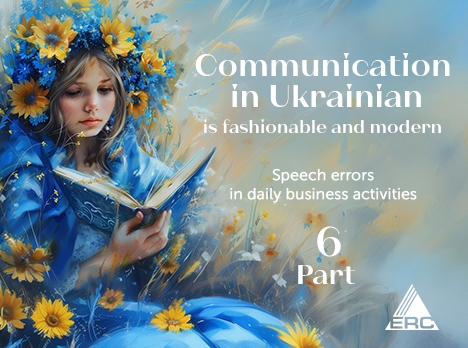
Communicating in Ukrainian is fashionable and modern. Speech errors in daily business activities. Part 6
Once again, we write about the real, hard-won present and the need for communication in Ukrainian. We offer advice on improving its usage and analyze typical mistakes in both business and everyday speech.
It’s unfortunate that not everyone pays attention to these articles. We ask you to reread the publications in previous magazines and correct the mistakes. Gently and with humor, when appropriate, let’s help each other improve. Let’s stop using calqued words, phrases, and expressions.
We encourage everyone not to be ashamed to start speaking Ukrainian – even with mistakes, even with an accent. The situation allows for this, and people around us understand. Sometimes it’s said that one needs to be at the front, where the language is used in its raw form, with all sorts of swearing, not refined. We’ll get there – time will tell. We’ve heard such comments. There are different stories – simple and complex – just like the history of the formation of our nation.
However, we believe that soft Ukrainian phrases and the typical Ukrainian swearing will have nothing to answer to supporters, friends, and allies. It will only irritate the enemy.
If you don’t want to or can’t speak Ukrainian – that’s fine. But the question arises: why does "don’t want to" sound increasingly worrying? Meanwhile, the attitude towards those who "can’t" is generally more sympathetic, understanding that there might be embarrassment due to imperfect pronunciation or difficulties in communication because of a limited vocabulary. This is exactly where publications in magazines and many other resources can be helpful. Yes, it’s not easy to start speaking Ukrainian if you lack the experience and the right environment. However, such a start can be surprisingly interesting and might impress everyone around you. After all, it’s each person’s choice.
But if you’ve already begun speaking Ukrainian, let’s improve it together! Not everyone can recall how it was in childhood, how their parents or grandparents spoke, and not everyone’s childhood or later life was filled with the Ukrainian flavor of songs, holidays, and traditions. Not everyone even learned Ukrainian in school, and do all of us read world literature in Ukrainian? However, speaking correctly is not only pleasant for yourself but also for those around you. Let’s help each other in this!
Let’s stop saying "доля" when we mean "частка", "вірно" when referring to correctness, "оберт" when we mean "товарообіг", "відношення" when describing an attitude towards something or someone, "беремо участь у заходах", and not "приймаємо"; let’s not confuse when to use "налічує" and when to use "нараховує", when to say "вважаємо" and when "рахуємо". Let’s start using the vocative case correctly and properly decline names when addressing people! Let’s rejoice in enriching our vocabulary and speaking more freely and colorfully.
Відволікати or відвертати?
Let’s admit it: we often say "не відволікай мене", "я відволікаюсь" and so on. This habit stems from the calquing of the Russian words "отвлекать" and "отвлекаться". In the Ukrainian language, "відволікати" is used only in its literal sense and is derived from the word "волокти", meaning to pull or drag something/someone along the ground. Instead, in the usual context, we should use "відвертати увагу", "відвертати(ся)", "відривати(ся)" or "відхиляти(ся)".
Миттєвість or мить?
Two words that are often used with the same meaning – a very short period of time. However, their semantics are still different. The Ukrainian "мить" corresponds to the Russian "мгновение" while "миттєвість" is analogous to the Russian "мгновенность", which denotes not time, but a quality (fleetingness, transience).
Миючий or мийний засіб?
The word "миючий" appeared in the Ukrainian language as a calque of the Russian "моющий." Academic translation dictionaries indicate the correct Ukrainian equivalent – "мийний."
This is just one of many similar calques. It should be noted that active participles ending in -уч(ий) or -юч(ий) (for example, "керуючий", "мотивуючий", "омолоджуючий") are not typical in modern literary language, so their usage should be limited. Instead, there are Ukrainian equivalents: "керівний," "мотивувальний," "омолоджувальний."
Дорогі ціни
Prices can be high (високими), and goods can be expensive (дорогими). However, the phrase "дорогі ціни" is incorrect and should be avoided. Instead, use "високі ціни" for high prices and "дорогі товари" for expensive goods.
Усміхатись or посміхатися?
Do people in portraits smile or grin? If a person's expression is friendly, gentle, or affectionate, they are smiling (усміхаються). However, if someone is mocking or scoffing, they are grinning (посміхаються). So, let’s remember: a soft and gentle smile is "усмішка", while a mocking or skeptical smile is "посмішка."
Заставляти or примушувати?
Why can’t you "заставити" Saint Nicholas to give out candies, but you can "заставити" a room? The words "заставляти" and "примушувати" have radically different meanings in Ukrainian. "Заставляти" is used in two contexts: to pawn something at a pawn shop, meaning to offer it as collateral, or to fill a space with items, such as furniture. On the other hand, "примушувати" means to compel someone to do something. For example: "After I filled (заставив) the room with toys, my mom forced (змусила) me to clean up".
Білет or квиток?
Why don’t you need to show "білет" to the controller, and why can’t you ever pull out "квиток" during an exam? Because the words "білет" and "квиток" are not synonyms. "Білет" is a card with exam questions or a card for a lottery. It is typically used in phrases like "екзаменаційний білет" (exam ticket) or "лотерейний білет" (lottery ticket). "Квиток," on the other hand, is a card for travel or one purchased for entry to a venue. Additionally, "квиток" can serve as a document that certifies membership in a particular organization, such as "студентський квиток" (student ID).
Бувший у використанні (б/в) – уживаний/вживаний
Another example of calquing from Russian, mentioned in many dictionaries. The abbreviation "б/в," which often appears in advertisements, corresponds to the phrase "бувший у використанні," which has nothing to do with literary norms. The correct terms to use are "уживаний" or "вживаний".
|
Surzhyk |
Correct form of the phrase |
English |
|
в любий день |
у будь-який день |
on any day |
|
вибачте мене |
вибачте мені |
forgive me |
|
виключення |
виняток |
exception |
|
гарно виглядати |
мати гарний вигляд |
look good |
|
заказати товар |
замовити товар |
order goods |
|
заключати договір |
укладати договір |
sign a contract |
|
згідно закону |
згідно із законом |
in accordance with the law |
|
здавати екзамен |
складати іспит |
take an exam |
|
кілька років назад |
кілька років тому |
a few years ago |
|
міроприємства |
заходи |
measures / actions |
|
на протязі місяця |
протягом місяця |
within a month |
|
на рахунок цього |
щодо цього |
regarding this |
|
нанести збитки |
завдати збитки |
cause damage |
|
не вмішуватися в справи |
не втручатися в справи |
not interfere in matters |
|
не дивлячись на перешкоди |
попри перешкоди |
despite the obstacles |
|
оточуюче середовище |
довкілля |
environment |
|
по крайній мірі |
принаймні |
at least |
|
потрапити на очі |
впасти у вічі |
catch one's eye |
|
приводити приклад |
наводити приклад |
give an example |
|
прийняти міри |
вжити заходів |
take measures |
|
прийшло в голову |
спало на думку |
it occurred to me |
|
проблема заключається |
проблема полягає |
the problem is |
|
слідуюча зупинка |
наступна зупинка |
next stop |
|
терпіння лопнуло |
терпець увірвався |
patience ran out |
|
приймати участь |
брати участь |
take part |
|
ведучий інженер |
провідний інженер |
lead engineer |
|
більше ста |
понад сто |
over a hundred |
|
в якості… |
у ролі… |
as… |
|
продовжується |
триває |
continues |
|
в кінці кінців |
врешті-решт |
ultimately |
|
в останній час |
останнім часом |
lately |
|
на цей рахунок |
щодо цього |
regarding this |
|
їхній |
їх |
them |
|
включити (виключити) світло |
вимикати/увімкнути світло |
turn off/on the light |
|
у комплекті іде |
у комплекті наявне |
included in the set |
|
відстрочка |
відтермінування |
postponement |
|
розстрочка |
на виплату |
hire purchase |
|
вибачаюся |
перепрошую |
excuse me |
|
переписка |
листування |
correspondence |
|
говорю на українській |
говорю українською |
I speak Ukrainian |
|
заключається |
полягає |
consists of (lies in) |
|
так як |
оскільки |
since |
|
задавати питання |
ставити питання |
ask a question |
|
на рахунок роботи |
щодо роботи |
regarding work |
|
рахую правильним |
вважаю правильним |
I consider it right |
|
робити вигляд |
вдавати |
pretend |
|
вирішувати проблему |
розв’язувати проблему |
solve the problem |
|
приймати участь |
брати участь |
take part |
|
виключення з правила |
виняток |
exception |
|
співпадіння |
збіг |
coincidence |
|
україномовний |
українськомовний |
Ukrainian-speaking |
|
відмінити |
скасувати |
cancel |
|
вважати необхідним |
вважати за потрібне |
deem it necessary |
|
багато в чому |
значно |
significantly |
|
давайте писати |
пишімо |
let's write |
|
давайте вчити нові слова |
вчимо нові слова |
let's learn new words |
|
давайте співати |
співаймо |
let's sing |
|
велике дякую |
дуже дякую |
thank you very much |
